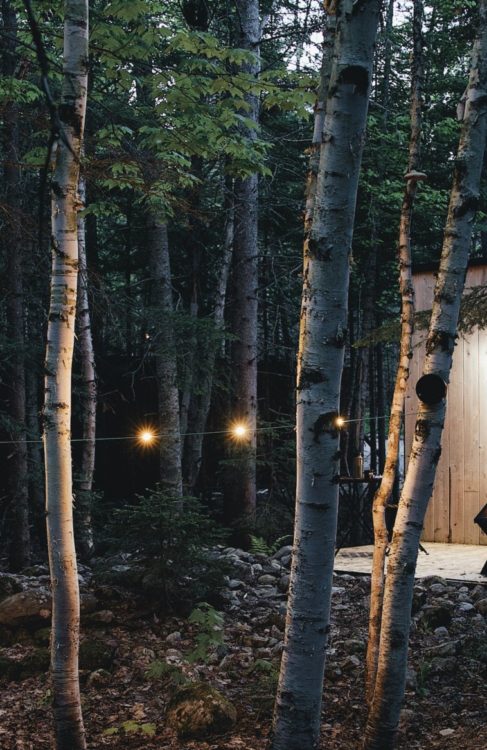

Why the Forest Actually Calms Your Brain
and How to Experience It at Repère Boréal, in Charlevoix
Leaving Repère Boréal forest, we feel so much calmer! 🌲 That’s what so many of you tell us after your visit. So we decided to find out what was actually going on. 🧠
A review of more than 100 brain imaging studies conducted by McGill University confirms what many people feel but can’t quite explain: spending time in nature reduces stress, restores attention, and calms mental restlessness.
“Measurable changes can be observed after just three minutes spent in a natural environment but generally, the longer and more immersive the experience, the more pronounced and lasting the effects.” — Mar Estarellas, postdoctoral researcher, McGill University
The Forest Changes Something in the Brain
In a forest, the brain receives fewer aggressive stimuli than in a city or in front of a screen. Sounds soften, shapes become organic, and the rhythm slows down. The brain works less hard and the body follows.
Heart rate decreases. Breathing deepens. The brain regions associated with stress and vigilance settle down. McGill researchers call this a cascade effect: one change naturally triggers the next (Baquedano et al., 2026).
Forest Bathing : A Practice From Japan
This phenomenon is so well documented that it gave rise to a recognized practice in Japan in the 1980s: shinrin-yoku, or forest bathing. The idea is simple, immerse yourself in the forest by gently engaging your senses: observe, breathe, listen.
The scientific evidence is consistent:
- A study of 498 participants (University of Kyoto, Morita et al., 2007) shows that anxiety decreases within the first minutes in the forest, with an even stronger effect in chronically stressed individuals.
- A study published in Frontiers in Psychology (Queirolo et al., 2024) measured, after two days in the forest, a significant drop in cortisol, the stress hormone, combined with improved heart rate regulation. Both are direct markers of a recovering nervous system.
4 ways to Restore Yourself in the Forest at Repère Boréal
At Repère Boréal, in the heart of Charlevoix’s boreal forest, this immersion happens almost effortlessly. Here are four simple ways to fully experience it during your stay.
1. Walk the trails
A walk on the trails near Repère Boréal is often enough to start the process. Fresh conifer air, ground beneath your feet, silence… the body begins to leave survival mode.
2. Breathe deeply in the Charlevoix forest air
As the environment quiets down, the body gradually exits high-alert mode. A few minutes by the fire or in the outdoor Nordic spa, included with every stay and your rhythm naturally shifts.
3. Let your attention wander in nature
In daily life, attention is constantly pulled: notifications, emails, decisions. In nature, attention becomes softer. Follow the movement of branches, watch clouds drift over the Charlevoix mountains, observe the light changing on the St. Lawrence River. This kind of diffuse attention allows the brain to recover from periods of intense stimulation.
4. Take time to do nothing
Often the hardest thing to do, and the most valuable. At Repère Boréal, this moment arrives in a light-filled bed, on a terrace at the end of the day, or watching the forest fall into the quiet of evening. Rumination fades. A deep inner calm settles in.
Repère Boréal : A Forest Retreat in Charlevoix built for Slowing Down
In a world that never stops, the forest offers something rarer: a space to truly slow down.
The accommodations at Repère Boréal ; Maïkan, Shiship, UHU, Mashk, Utapi, Nish open directly onto the boreal forest of Charlevoix, with floor-to-ceiling panoramic windows, heated floors, and a Nordic spa included with every stay. An environment designed so that body and mind can find their natural rhythm again.
Repère Boréal is a nature hotel retreat located in Les Éboulements, Charlevoix, Québec. Open year-round. Dogs welcome.
Sometimes it all begins with one simple gesture: opening the door of your room in the forest, breathing in the fresh Charlevoix air, and letting nature do the rest.
References
Baquedano, C., Estarellas, M., et al. (2026). Your brain on nature: A scoping review of the neuroscience of nature exposure. Neuroscience & Biobehavioral Reviews.
Dutrisac, R. (2026, 4 mars). Démonstration de l’importance d’être exposé à la nature pour notre cerveau. La Presse. https://www.lapresse.ca/actualites/sciences/2026-03-04/etude/demonstration-de-l-importance-d-etre-expose-a-la-nature-pour-notre-cerveau.php
Li, Q. (2018). Forest bathing: How trees can help you find health and happiness. Viking.
Queirolo, L., et al. (2024). Effects of forest bathing (Shinrin-yoku) in stressed people. Frontiers in Psychology, 15, 1458418. https://doi.org/10.3389/fpsyg.2024.1458418
McGill University & Universidad Adolfo Ibáñez. Li, Q. (2018). Forest bathing: How trees can help you find health and happiness. https://www.mcgill.ca/newsroom/fr/channels/news/le-contact-avec-la-nature-un-baume-pour-le-cerveau-371263
Viking. Morita, E., et al. (2007). Psychological effects of forest environments on healthy adults. Public Health, 121(1), 54–63.https://doi.org/10.1016/j.puhe.2006.05.024